Natural Resources Worksheet Ideas for Elementary Class
A natural resources worksheet works best when students can connect each resource to an object they use every day. This guide sets out the key ideas, from renewable and nonrenewable resources to conservation, with sorting tasks, simple investigations and reading passages on energy and the environment.
What natural resources are
Natural resources are materials found in the environment that people use. Some are things we can see and hold, such as water, soil, wood and metal. Others are harder to hold, such as sunlight, wind and air.
Ask students to look around the classroom and name something that began as a natural resource. Their answers show that almost everything has a starting point in the environment:
- A wooden pencil starts with trees.
- A sheet of paper also starts with trees.
- A metal paper clip starts with metal taken from the ground.
- A glass window is made with sand.
- A plastic ruler is made from oil.
These links are a good way into the unit, because the topic stops being abstract. Every object in the room has a story that begins outdoors.
Types of natural resources
Students can sort resources by where they are found.
- Water: used for drinking, washing, growing food and many other things.
- Air: living things need it to breathe, and wind is moving air.
- Soil: plants grow in it, and it holds water and nutrients.
- Plants and trees: give us food, wood and paper.
- Minerals and metals: found in the ground and used for tools, buildings and wires.
- Fossil fuels: coal, oil and natural gas, used to make energy.
- Sunlight: a source of heat, light and energy.
A simple worksheet can give students a list of items and ask them to match each one to the resource it came from. Start with common items such as a bicycle tire, a wooden desk and a glass of water, then add a few that need more thought.
Renewable and nonrenewable resources
This is the sorting that matters most in a natural resources unit.
- Renewable resources can be replaced in a fairly short time, or they do not run out. Sunlight, wind and flowing water are examples. Trees are renewable when new ones are planted to replace those that are cut.
- Nonrenewable resources are used up much faster than they can be replaced. Coal, oil and natural gas formed over millions of years from the remains of ancient plants and animals, so we cannot make more in a lifetime.
Offer a quick sorting list: sunlight, wind, coal, oil, natural gas, water in a river, and trees in a managed forest. Ask students to place each in one of two columns and give a reason. If they hesitate over trees, use it as a talking point. A tree is renewable only if people plant new ones, and it takes years to grow.
Our guide to renewable energy sources goes deeper on the energy side of this idea.
Fossil fuels in plain words
Coal, oil and natural gas are called fossil fuels. They are burned to make heat and electricity and to power many vehicles. Students should know two facts about them: they take a very long time to form, and burning them releases gases into the air.
A short reading and writing task fits well here. Ask students to explain in two or three sentences why fossil fuels are called nonrenewable. A good answer says that they take millions of years to form and are being used much faster than they can be replaced.
Renewable energy resources
Several renewable resources can be turned into electricity. Short reading passages let students meet each one in turn.
Solar energy
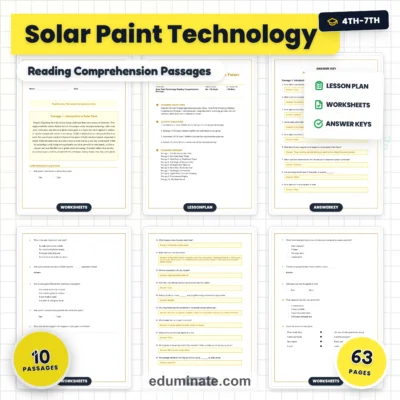
Sunlight can be captured and used as energy. The Solar Energy Worksheets packet has 63 pages and teaches solar paint reading comprehension through green technology topics, with quantum dots, hydrogen generation, perovskite minerals and renewable energy.
Wind energy
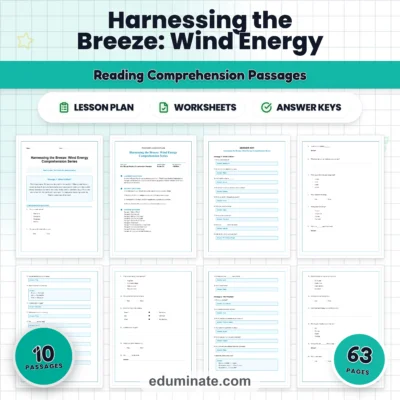
Moving air can turn a machine that makes electricity. The Wind Power Worksheets packet has 10 passages across 63 pages, with text dependent questions, a structured lesson plan and answer keys for grades 2 to 8.
Geothermal energy
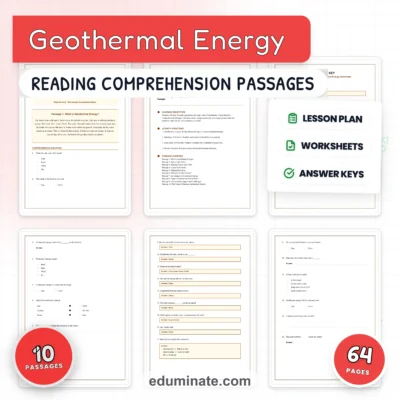
Heat from deep underground can be used to make steam. The Geothermal Energy Worksheets packet has 64 pages exploring underground heat, steam turbines, power plants and renewable electricity, across 10 passages for grades 3 to 7.
Energy from waste
Some towns use their trash as a fuel. The Renewable Energy Worksheets on waste to energy run to 72 pages across ten passages on municipal waste combustion, steam power generation, pollution scrubbers and global recycling, with full questions and answer keys.
If you want all of these in one download, the Renewable Energy Reading Comprehension Bundle brings eight reading packets together, covering solar, wind, geothermal and waste to energy, in 527 pages.
Conservation: reduce, reuse, recycle
Conservation means using resources carefully so that they last. The familiar three words give students an easy way to remember it.
- Reduce: use less. Turn off a light when you leave a room, and turn off a tap while brushing teeth.
- Reuse: use something again. A glass jar can hold pencils, and the back of a used sheet of paper can be scrap paper.
- Recycle: turn used material into something new. Paper, metal cans, glass and some plastics can be recycled.
Ask each student to choose one action they could take at home or at school, and to write a sentence about which resource it protects. For example: “If I turn off the tap while I brush my teeth, I save water.”
The Cleaning the Environment Reading Comprehension packet has 62 pages and 10 reading passages for grades 2 to 7 on recycling, waste reduction, clean water and community stewardship. It gives conservation lessons a reading base.
Clean water as a natural resource
Water is a good case study, because students can see it and use it every day. Fresh water can be used for drinking, cooking, washing and growing food, and it has to be kept clean to stay useful.
Try this simple observation. Put a spoonful of soil in a clear jar of water and shake it. Let it sit and watch the soil settle. Ask students what they notice, and why a person would not want to drink the water in that state. Then talk about how communities keep water clean, such as filtering it and not putting trash in rivers.
A natural resources worksheet: a short classroom task
Here is one way to build your own natural resources worksheet for the end of a lesson. Students complete three parts:
- Match each object to the resource it comes from: pencil, paper clip, window, bicycle tire.
- Sort a list into renewable and nonrenewable.
- Write two sentences about one way to save a resource.
Check the answers together. For the match, a wooden pencil comes from trees, a paper clip from metal, a window from sand, and a bicycle tire from rubber or oil. The sorting shows who has understood the main idea.
A resource audit of the classroom
For a hands-on project, ask groups to list five things in the room and trace each one back to a resource. Then ask which resources are renewable and which are not. Groups can share their findings at the board.
The audit makes the point that resources are in everything. It also leads naturally into conservation, because students start to notice how often they use paper, water and electricity.
Soil, trees and metals: three close-up looks
Pick two or three resources and look at them closely. Each one shows a different side of the same idea.
Soil
Plants grow in soil, and most of our food begins with plants. Soil forms very slowly, so it is worth protecting. Ask students to look at a handful of soil with a magnifying glass and list what they can see, such as tiny stones, bits of dead leaves and small roots.
Trees
Trees give wood and paper. They are renewable when new trees are planted, but a young tree needs years to grow. Ask students to count how many things in the room are made of wood or paper, and to think about what it would mean to use less of them.
Metals
Metals come from the ground and cannot be regrown. A metal can that is recycled can be made into a new metal object, so recycling saves the material for another use. Ask students to explain in a sentence why a recycled can is better than a thrown away can.
Comparing two energy resources
A comparison chart is a strong way to wrap up the reading. Choose two resources, such as coal and wind, and give students these rows to fill in:
- What is the resource?
- Is it renewable or nonrenewable?
- How is it turned into electricity?
- What is one advantage, and one problem?
Ask students to base their answers on the passages they read and to point to the sentence that supports each one. If a student can explain why wind is renewable and coal is not, the main idea has landed.
Vocabulary for a resources unit
Keep a word list on the board: resource, renewable, nonrenewable, fossil fuel, conservation, recycle, reuse, reduce, pollution. Ask students to write a short meaning for each in their own words. At the end of the unit, ask them to write a paragraph that uses at least four of the words. Their paragraph shows how well the ideas fit together.
Questions to ask while students read
- Which resource does this text describe, and is it renewable?
- How do people use it?
- What is one good thing and one challenge about using it?
- What could a student do to use less of it?
Short questions like these keep students reading with a purpose and give you something concrete to discuss afterward.
Frequently asked questions
What are natural resources?
Materials found in the environment that people use, such as water, air, soil, wood, minerals and sunlight.
What is the difference between renewable and nonrenewable resources?
Renewable resources can be replaced fairly quickly or do not run out, like sunlight and wind. Nonrenewable resources, like coal, oil and natural gas, take millions of years to form.
Why is conservation important?
Conservation means using resources carefully so that they last. It helps keep water clean and makes resources available for longer.
How can I teach natural resources without a field trip?
Use everyday classroom objects, a few simple water and soil observations, and short reading passages on energy and the environment.